
OCT 2026
OPS-SAT PRETTY is the first satellite to understand a spoken command and carry it out. Tanagra Space and volunteer radio amateurs in Norway designed and ran the experiment. The experiment flew through OPS-SAT Space Lab, a European Space Agency (ESA) service, with TU Graz supporting spacecraft operations.
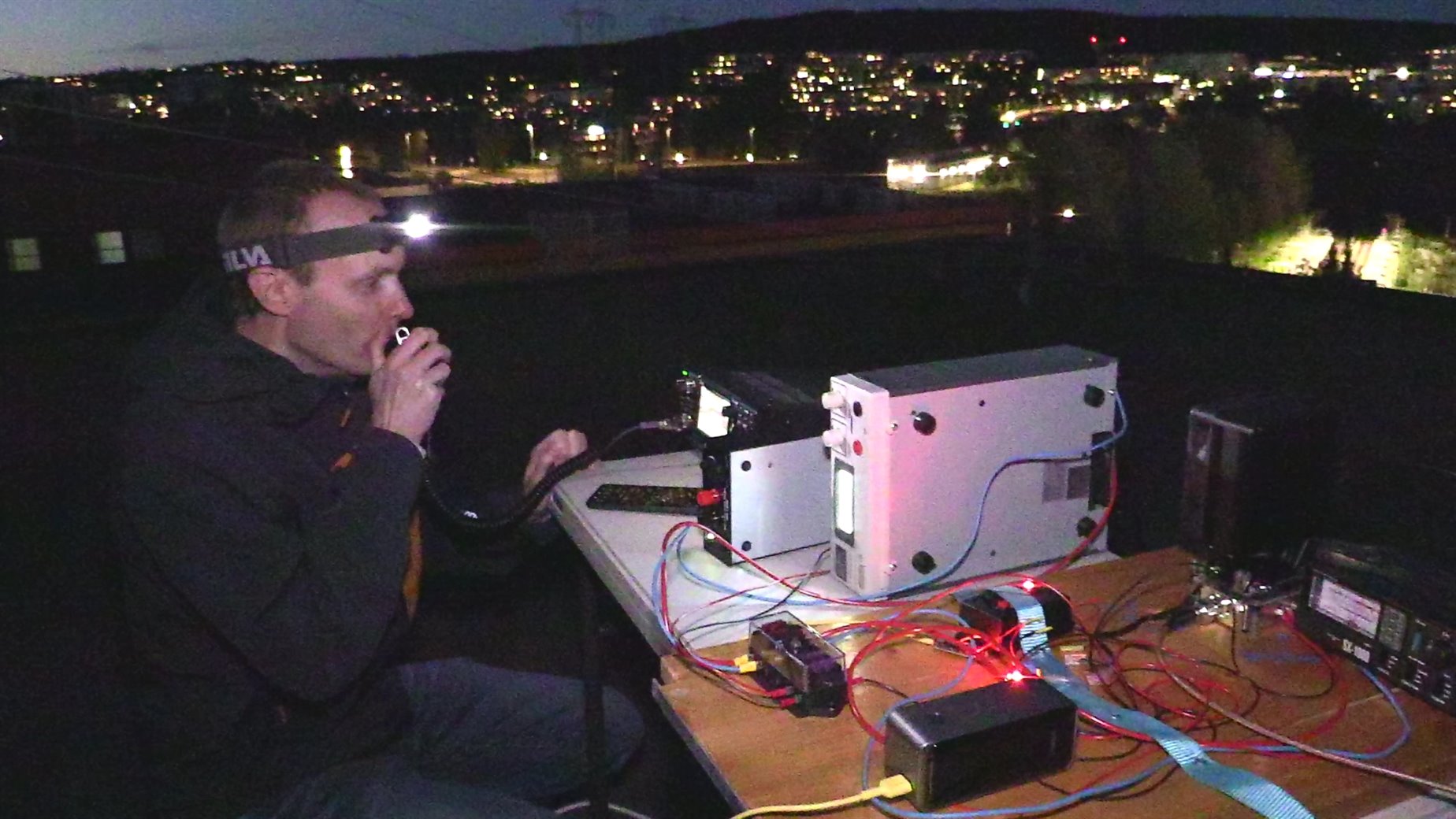
On 27 July 2026, a radio amateur on a rooftop in Oslo spoke into a microphone: “LIMA ALFA FOUR OSCAR, PRETTY PLAY DOOM DOOM DOOM, PRETTY PLAY DOOM DOOM DOOM.” Overhead, ESA’s OPS-SAT PRETTY satellite captured the transmission and transcribed it with a speech recognition model running on board. It found the command and launched DOOM, the classic 1993 first-person shooter video game.
Repurposing a Science Satellite
Receiving voice commands was not part of the original spacecraft design of the OPS-SAT PRETTY mission. The satellite’s primary mission is GNSS reflectometry and radiation monitoring. Almost three years after launch, new software developed by Tanagra Space was uploaded to the satellite. The software taught the satellite to listen for a human voice, on a frequency its antennas were never designed for.
That flexibility is rare in spacecraft design. It comes from a reconfigurable onboard computer and a software-defined radio. With them, a mission can take on new work through a software update.
“ESA’s OPS-SAT Space Lab satellites give experimenters all over the world an opportunity to try their ideas on-board a real, flying mission. Running all these different experiments requires flexibility both from the spacecraft design and its operational team.”
Vladimir Zelenevskiy, Experimenter and former OPS-SAT-1 Mission Control Team engineer.
OPS-SAT Space Lab, ESA’s service for outside experimenters, embraced the idea and let volunteer radio amateurs transmit to the spacecraft. The mission operations teams at ESA’s European Space Operations Centre (ESOC) and TU Graz scheduled passes over amateur ground stations in Poland and Norway. It took seven flight runs, from April to July, to get the command through.
“Not many teams get to point a radio at an orbiting ESA spacecraft and try something nobody has done before. Thank you to ESA and OPS-SAT Space Lab for this unique opportunity, and to the ESOC and TU Graz operators who made every pass happen.”
Georges Labrèche, Founder and Principal Investigator, Tanagra Space.
The Radio Amateurs
Volunteer radio amateurs were the ground segment. Operators in Legnica, Poland, made the first four attempts from April to June 2026. In July, the Oslo Group of the Norwegian Radio Relay League (LA4O) took over.
Feedback from the radio amateurs also changed the flight software. In a raw recording from their first attempt on 3 July, the Oslo team could recognize the operator’s voice but not the words. Their analysis showed that the receiver channel on board was far wider than the voice signal and they proposed narrowing it.
On most satellite missions changing flight software takes months of reviews. On OPS-SAT PRETTY it took only a handful of volunteers on a rooftop ground station to propose a fix that Tanagra Space developed the same day and delivered to ESA as updated flight software about a week later.
“We are radio amateurs, with the emphasis on amateurs. Satellite work was not something our club did, and we had no budget for it. So we borrowed a line wrongly credited to Pippi Longstocking: ‘I have never tried that before, so I should definitely be able to do that.’ Fifty-nine days and about 7,200 NOK later, pizza included, our tiny ground station shouted at an ESA spacecraft and was heard.”
Eskil Hadland (LB6AJ), Oslo Group of the Norwegian Radio Relay League (LA4O).
What the Satellite Sent Back
After launching DOOM, the payload computer put together a report for the ground team:
- Screenshots and a frame-by-frame animation of the gameplay.
- The transcription, command detection scores, and signal level statistics for each capture.
- A spectrogram, a constellation plot, and a power spectrum of each radio capture.
- A postcard that combines a gameplay frame, the transcription, and the signal diagnostics.
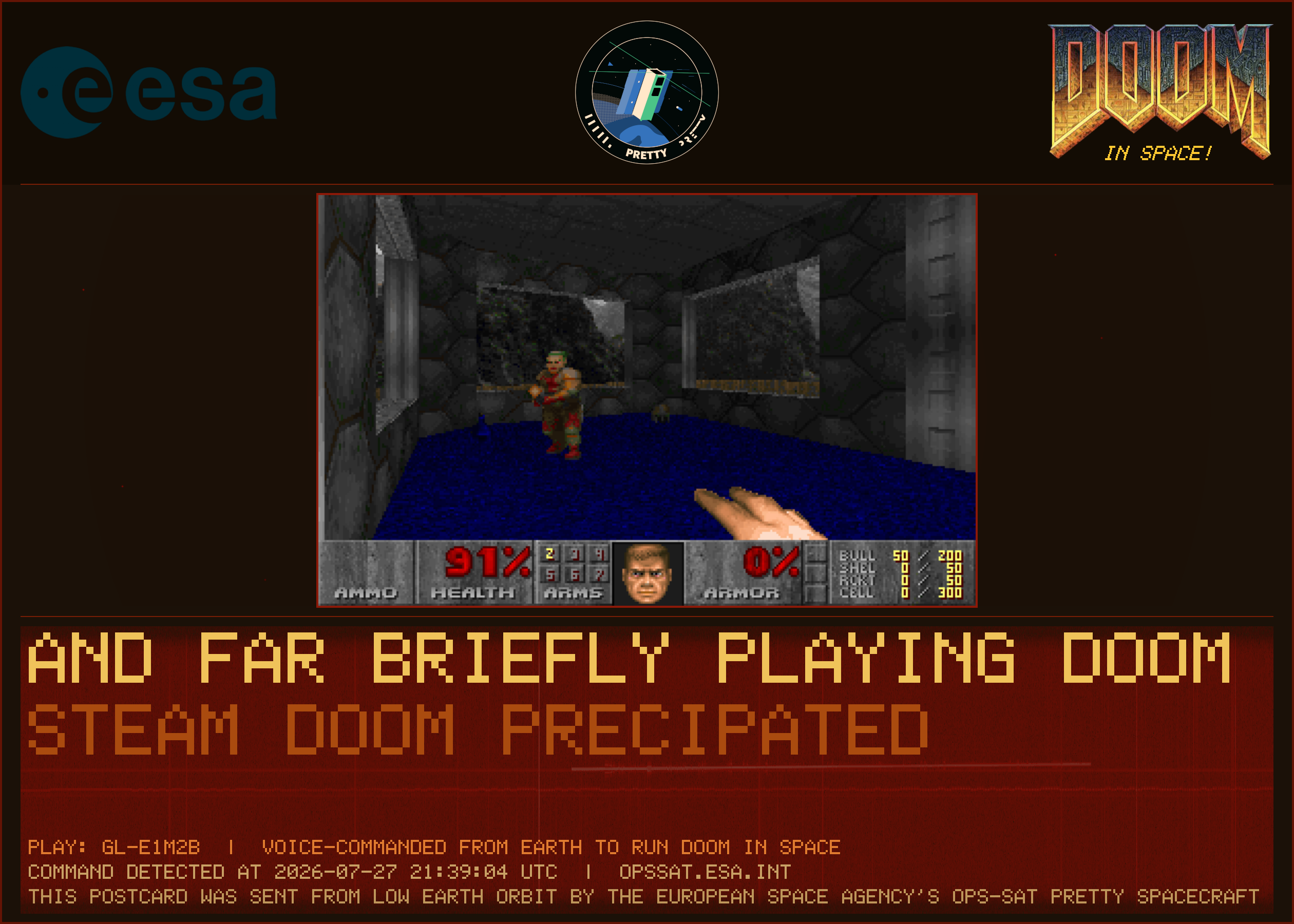
“The key part of being able to pull this off is the portability and deterministic aspect of DOOM.”
Ólafur Waage, Experiment Co-Designer and Co-Developer.
The satellite also sent back its own recording of the live voice command:
Detecting Signals That Are Not Precisely Defined
No two people say “PLAY DOOM” the same way. Noise, Doppler shift, and an antenna tuned for a different frequency distort the signal further, but PRETTY still detected the command. The signal processing ran on GNU Radio and the speech recognition on Sherpa-ONNX, two open-source tools that also run on ordinary home computers and edge devices.
“This experiment is fun, but the idea behind it is key. Space-ground communication is normally defined precisely, down to the bit sequence. Here, a reconfigurable software-defined radio, a powerful processor, and terrestrial software repurposed for in-space applications detected something that is not very well defined, a human voice.”
David Evans, Head of OPS-SAT Space Lab, ESA.
Jamming, misuse of protected frequencies, and distress signals are just as hard to define in advance. The same approach can detect them. Analyzing these signals on the ground means waiting for a ground station pass and then for a person to review the data. A satellite that detects and recognizes the signal on board can react right away and send down readily available results.
Other Signals a Satellite Could Listen For
Recognizing a voice from orbit is useful for more than commands. Someone in distress at sea or in a remote area could transmit “mayday” or “help” on a radio. A satellite overhead could detect the call, transcribe it, and use AI to work out the language and how urgent the call is. It could then pass an alert to rescue services without waiting for a ground station to process a recording.
The speech model on board was only about 27 MB. Its transcription of the live voice was rough but it still caught the command. A larger model could understand full sentences and their context.
“The voice was only the test signal. With PRETTY, we’ve demonstrated a satellite that can listen to any type of radio signal and act on what it hears. The same setup becomes a different instrument when trained on something other than speech.”
Georges Labrèche, Founder and Principal Investigator, Tanagra Space.
Future missions can take this approach well beyond voice. A radio telescope satellite could carry a model trained to catch bursts from deep space and downlink only the bursts it finds. A new application does not need new hardware. Operators only have to uplink a different model to a spacecraft that is already in orbit.
Resources
- Project page
- Source code and flight record
- Oslo (LA4O) campaign report
- Video: DOOM In Space with Voice Commands
- OPS-SAT Space Lab: register an experiment
About Tanagra Space
Tanagra Space develops machine learning for autonomous decision-making in space. Its software runs on board spacecraft, so missions can detect, decide, and act in orbit without waiting for the ground. Tanagra Space has flown experiments and technology demonstrators on ESA’s OPS-SAT spacecraft.