

What happened
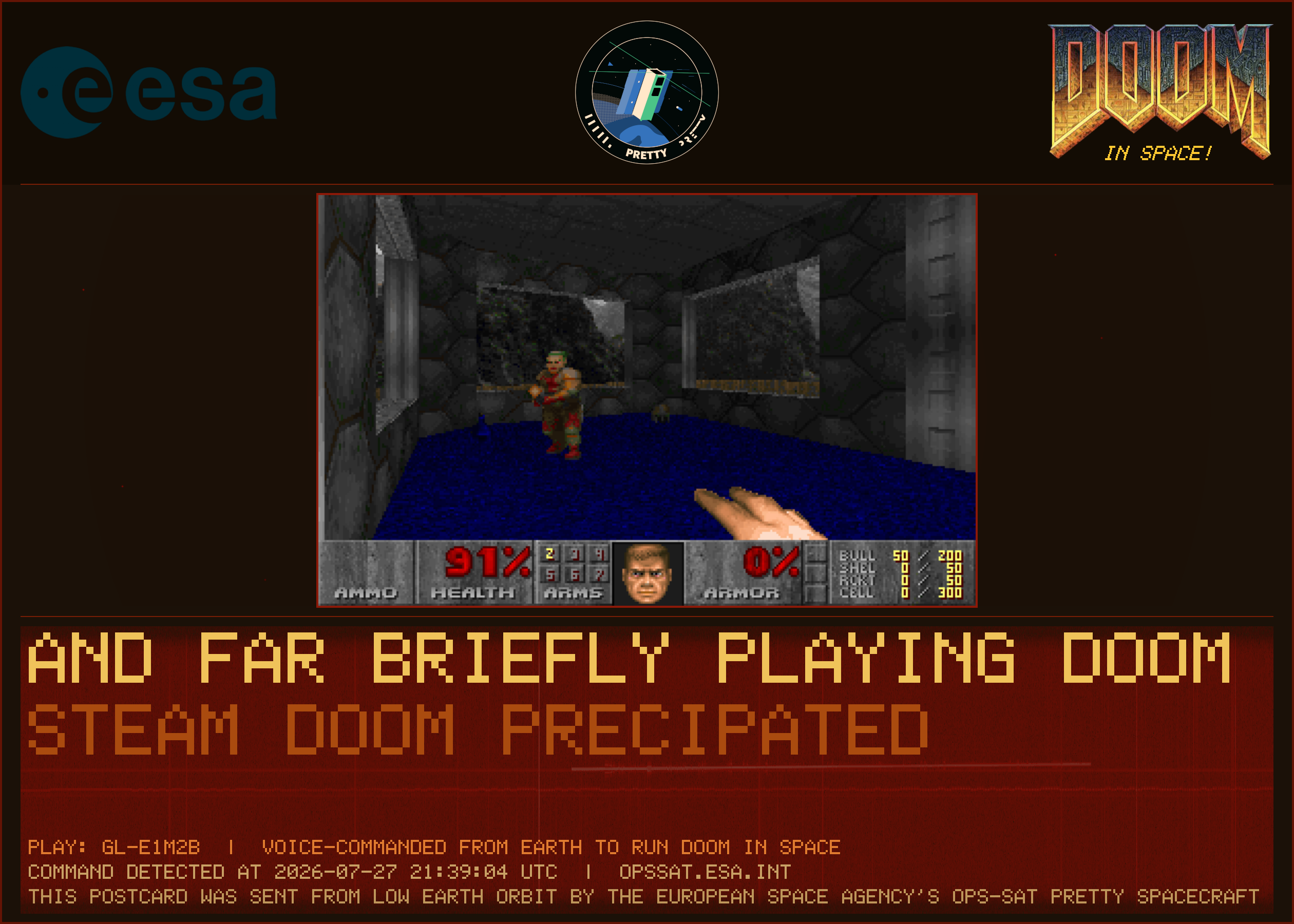
A radio amateur group based in Oslo transmitted a spoken command on the 23 cm amateur radio band to OPS-SAT PRETTY, an experimental European Space Agency (ESA) satellite. On board and with no human in the loop, the satellite captured the radio signal, recovered the voice from the noise, transcribed it with a speech-to-text AI model, detected the command, launched the 1993 game DOOM, and then downlinked a "postcard" image of the moment.
It happened twice on the same day. On the morning pass the team transmitted a synthesized voice on a loop. That evening an operator spoke the command live into a microphone, and the satellite detected that too.
It had never been done before. Satellites are normally commanded with telecommands: structured binary packets uplinked during scheduled passes and built to strict protocols, such as the CCSDS TC Space Data Link Protocol and the European Packet Utilisation Standard (PUS). This is the first time a satellite has been commanded by voice in plain spoken language and has acted on the command autonomously in orbit.
How it works
The command travels from a microphone on the ground to a game launching in space in a handful of steps, all running on the satellite's small onboard computer:
Capture
The satellite's software radio records the radio signal as the spacecraft flies over the ground station.
Narrow in
It finds the voice buried in the noise and tunes in to just that sliver of the spectrum.
Transcribe
An onboard speech-to-text AI model turns the recovered audio into words.
Recognize
A matcher checks the words for the command, tolerant of the mangling caused by a noisy radio link.
Launch DOOM
On a match, the satellite plays DOOM and renders a postcard from the gameplay and the signal, then downlinks it.
A first
DOOM, played in orbit, launched by a human voice from the ground. The first time a satellite has been commanded by voice.
The milestone passes
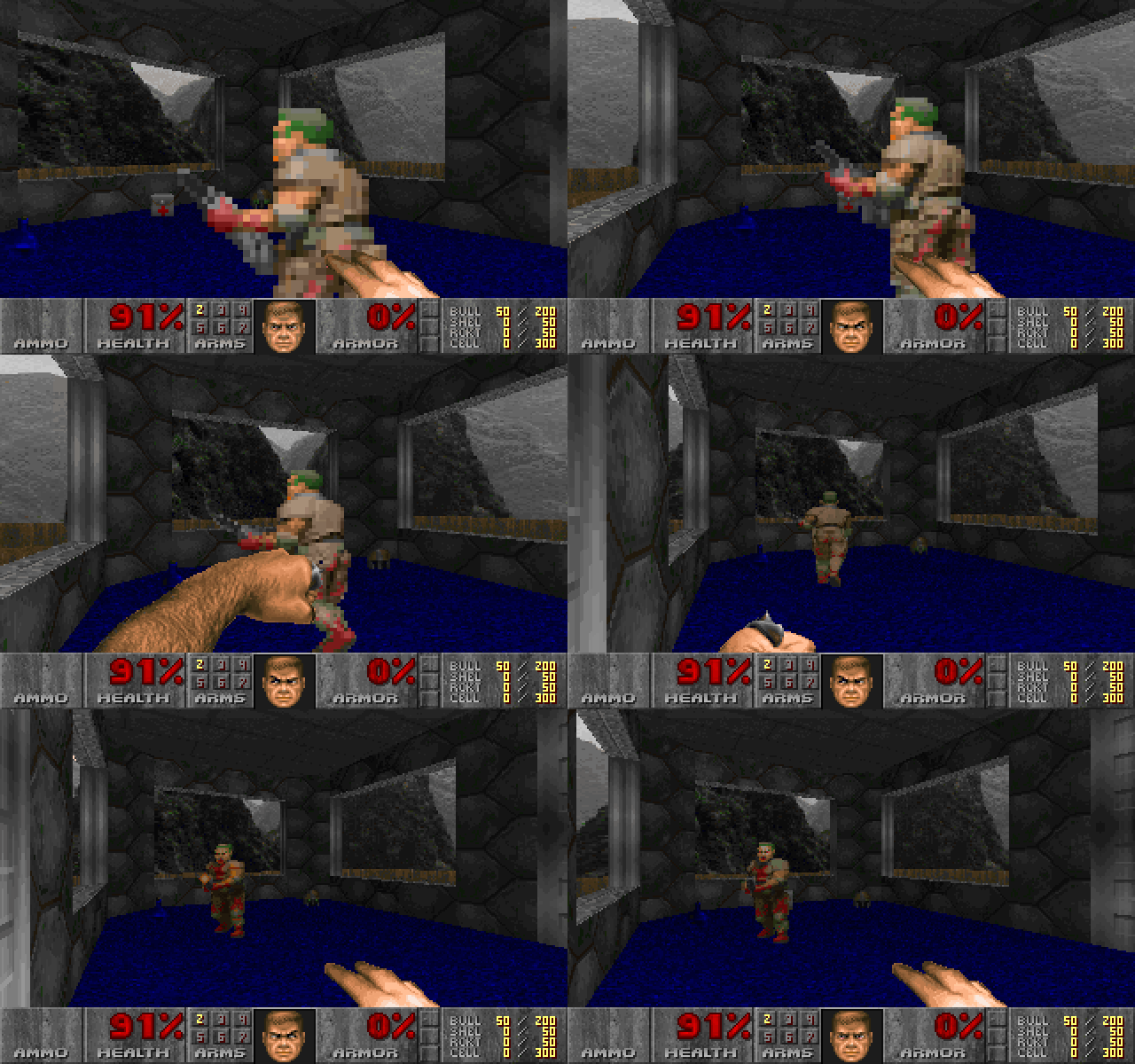
The satellite detected the command and launched DOOM on two passes over Oslo on the same day. The Oslo radio amateur team transmitted on both:
Run 6
The team transmitted a synthesized voice message from a keyer, on a loop. The satellite detected the command and launched DOOM.
Run 7
This time an operator spoke the command live into a microphone, no keyer and no recording. The satellite detected it again, the first detection of a live human voice from orbit.
Who made it happen
The experiment depended on the amateur radio community, who formed its ground segment. The transmissions were made by two volunteer radio amateur teams:
- Oslo Group of the Norwegian Radio Relay League (NRRL), who ran the successful July 2026 campaign from a rooftop in Oslo under the club call sign LA4O.
- Radio amateurs in Legnica, Poland, who ran the earlier link tests from April to June 2026 under the call signs SQ6RDP and SQ6QV.
Full radio amateur credits are in the project acknowledgements.
The experiment flew on the European Space Agency's OPS-SAT PRETTY spacecraft, with passes scheduled and operated by the OPS-SAT mission operations team. Thanks also to Maximilian Henkel, Ólafur Waage, and Vladimir Zelenevskiy for their collaboration and support throughout the campaign.
The experiment was led by Georges Labrèche, principal investigator and researcher.